
Paella

We are all familiar with and partake of ethnic food … Japanese, Chinese, Thai, Mexican, Italian, German, French, Indian, Mediterranean, Spanish … and the list goes on and on. But what makes a food ethnic?
The concept of ethnic food is multifaceted, complex, woven by threads of history, tradition, culture, geography, identity, climate, and, of course, local ingredients. It is a culinary reflection of values, beliefs and practices. It is a social experience that transports us to a different time, place and culture of traditions and values. It is more than just the food itself; the food is a reflection of rituals, ceremonies, and traditions, even down to the choice of ingredients and cooking techniques. These are all stories about the people that created the food and maintain its existence today.
To many people, especially foodies, the mere mention of Spain evokes paella, the beacon of Spanish culinary arts. One of hottest culinary trends is fusion cooking, combining ingredients, techniques, and seasonings from different cuisines. Paella is itself the fusion of cultures, from the Romans to the Moors to today. Modern paella is an exotic, full-flavored amalgamation of rice, meat and vegetables that reflects the cultures of its history and celebrates the rich and diverse flavors of Spain.
We have to travel back in history to understand the origin of paella. What we today know as paella sprung from the rural agricultural areas surrounding the Alubufera Lagoon just south of Valencia, Spain, along the Mediterranean coast in the 15th century. Farmers and laborers would prepare a simple meal with whatever ingredients they had at hand, rabbit, chicken, land snails, local vegetables, over an open fire in a wide, shallow pan known as a “paellera.” This shallow pan, introduced to the Iberian peninsula by the Romans, allowed even cooking and development of the dish’s signature crust at the bottom, the “socarrat.” The name “paella” is derived from the Old French word “paella,” which word itself is derived from the Latin “patella,” all of which mean pan. The Moors introduced rice and saffron into the Iberian peninsula in the 8th century and forever altered Spanish cuisine, including paella.
Let’s start with the modern pan. Your first decision is whether you want carbon steel, aluminum, or stainless steel. There are even enameled cast iron, ceramic, and copper paella pans. Commercial pans sometimes have a rounded bottom that is awkward on most traditional stoves. You want a pan with a dimpled flat bottom and a wide and shallow cooking surface. Another factor is maintenance; carbon steel must be seasoned before use and requires care in cleaning. For those who demand high authenticity, Garcima pans have been manufactured in Valencia for generations.
https://garcima.com
In the photo the pans left to right are: carbon steel, enameled steel, stainless steel, Pata Negra (extra-thick and heavy-duty grade carbon steel), and flat bottom.

How large a paella pan do you need? Naturally, you can find charts on the Internet that give recommended pan sizes from one person to 50 or more; 24 cm (9 in) to 90 cm (36 in). Our local paella emporium has a 4-foot pan for approximately 160 servings that is used regularly and takes more than one person to handle. Stovetop pans are typically up to 15 in (38 cm) that serve about 8 people. Oven pans go up 18 in (46 cm) and 12 servings. 20 in (50 cm; 13 servings) pans are typically used with a paella burner (about which we will get to).
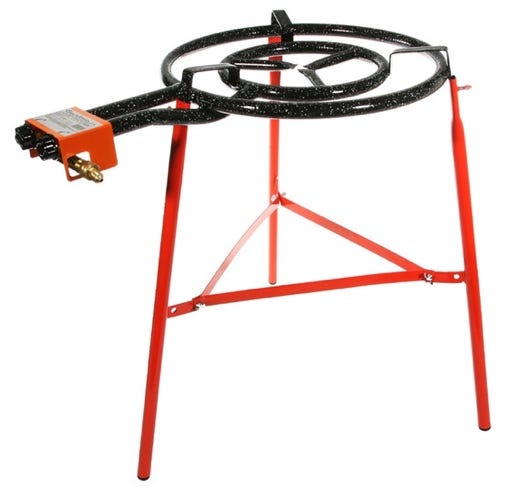
Now about the heat source. Almost everyone has access to an oven and a stovetop, and there are recipes for making paella using each source. The primary objective is even heating across the entire pan. Historically paella was cooked over an open flame wood fire. Purists claim cooking over an open flame reflects not only the history of the creation of paella, but yields a more flavorful paella. First, the wide, shallow paella pan was specifically designed for even heat distribution over an open flame. Paella is not considered perfect without the socarrat, the crispy, golden layer at the bottom of the pan. Cooking over fire allows precise heat control; you can shift the pan and rotate it to provide even heat from below. Especially for a seafood paella heat control is essential; delicate seafood cook at different temperatures and times that are difficult to control on a stovetop or in the oven. An open flame in and of itself induces subtle flavor differences beyond those created by just a wood fire. Cooking over an open flame is a communal event; people are drawn to an open flame just like “a moth to a candle.” Most of us do not have access to open flame fires; fortunately technology provides a solution, a propane-fed burner specifically designed for paella pans. There are different size burners for different pan sizes, two to three burner rings, on a stand, on wheels. Burners may be used on countertops with appropriate surface heat protection and ventilation. Sorry, paella is not a microwave dish !!!
The foundation of any good paella, or any dish for that matter, is the quality of the ingredients. Paella makers in Valencia accommodate any kind of rice, but short-grain Bomba or Calasparra rice varieties are preferred because of their unique ability to absorb flavors while maintaining a firm texture. You can find these rice varieties in specialty grocery stores or online. What’s next?
There are literally hundreds of “paella” recipes on line, with almost as many “paella” cookbooks. Let’s start with what is considered the “original” paella, Valencia paella for four people.
Recipe: Valencia paella
300 g (12 oz) chicken cut into small pieces (thighs, drums, wings)
200 g (7-8 oz) rabbit cut into small pieces
Land snails You can find food quality land snails online.
2 large ripe tomatoes
200 g (7 oz) garrofó Ok, what’s garrofó, also known as garrofón? Garrofón are traditional mild and creamy Spanish butter beans grown around Valencia. They are a special variety of lima beans, and are generally sold fresh, dried or frozen. You can find the dried beans online.
100 g (3.5 oz) flat green beans Also known as romano beans, helda beans, or Italian green beans are a variety of the common bean (Phaseolus vulgaris) characterized by their wide, flat shape. Use ordinary green beans as a substitute.

3 dried ñora peppersÑora peppers are mild Spanish red bell peppers predominantly grown in Eastern Spain.They impart a distinct sweet and lightly earthy and smoky flavor.Ñora peppers are available online, or substitute other mild pepper.
320 g (12 oz) short-grain rice We talked about rice choices above … Bomba or Calasparra … available online.
5 cups water
1 sprig rosemary
1 tsp saffron threads
2 tsp sweet paprika powder Note: “sweet,” not smoked or Hungarian.
2 tsp salt
3 tbs olive oil (preferably Virgin or “lite,” not Extra Virgin)
You will need a 12 to 15-inch paella pan (yes, you can use pans other than official “paella” pans …). Cast iron is preferred.
1. Cut the tomatoes in half and grate the pulp with a fine grater. Set pulp aside.
2. Trim the ends of the green beans. Set aside.
3. Add olive oil to paella pan and heat on medium.
4. Add chicken and rabbit, season with salt, and cook until browned on all sides … about 10 minutes.
5. Add the garrofó and green beans and cook until slightly browned … about 5 minutes.
6. Move the meat and vegetables to the sides of the paella pan.
7. Add the grated tomato pulp and mix well with paprika.
8. Mix together everything in the paella pan so every piece is covered in the tomato pulp mixture.
9. Add the water, rosemary spring and saffron threads.
10. Boil on medium for 10 to 15 minutes. Taste the broth and adjust with salt as needed.
11. Add the rice and mix well with wooden spoon. Cook on high heat for 10 to 12 minutes, and then lower the heat to medium for an additional 3 to 5 minutes to allow the socarrat to form. Some recipes admonish do not stir the rice once mixed and coated.
12. If the rice is still somewhat too hard, cover the pan and let the paella sit for a few minutes off the heat.
13. Serve with lemon wedges. Viola!
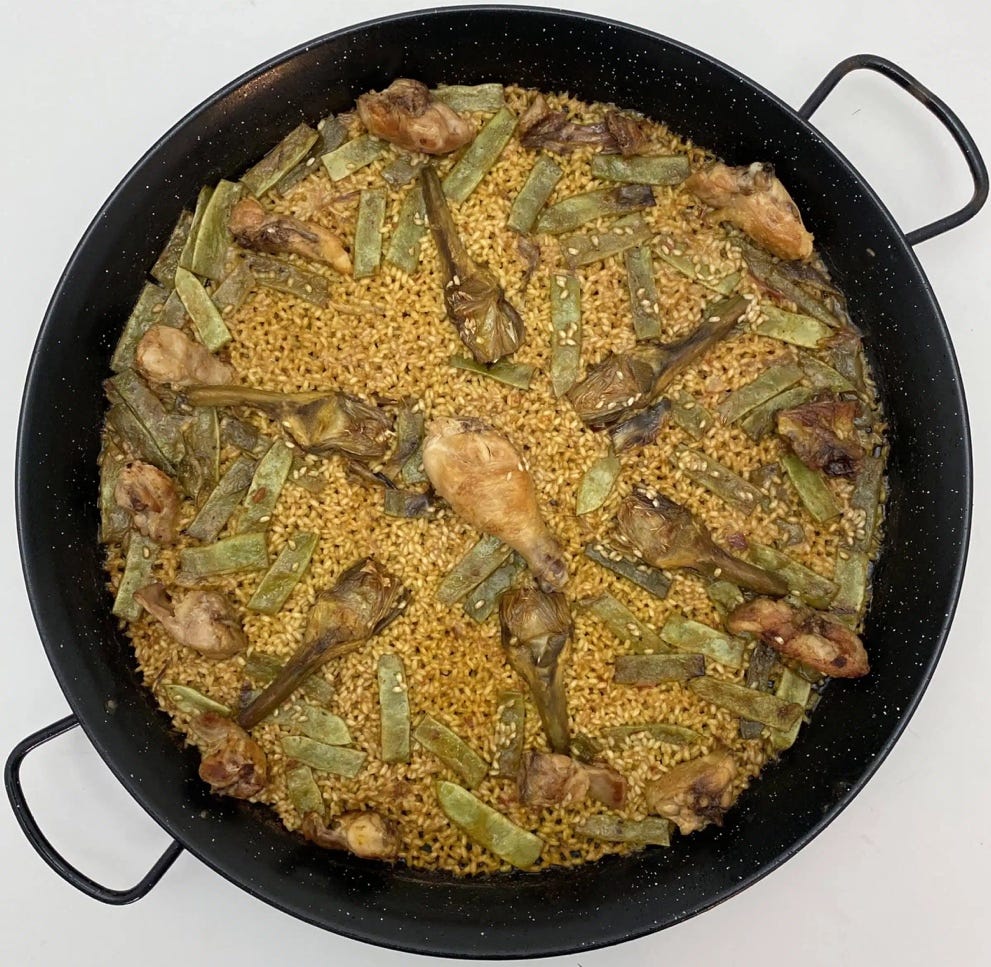
To the most traditional Valencians, Valencia paella is the only true paella. Any other akin dish is termed arroz con cosas, simply “rice with things.”
Paella came into existence along the Mediterranean coast of Spain. The natural evolution of paella was fishermen’s paella de marisco in which the meat is replaced with seafood, and the some beans omitted. Here the seafood is served in the shell, primarily muscles, clams, and shrimp. Crab, lobster, squid, and varieties of fish are also frequently included. Of special note is the inclusion of chorizo, particularly Iberian chorizo, in most seafood paella.
Recipe: Seafood paella for six
3 tbs olive oil (preferably Virgin or “lite,” not Extra Virgin)
5 cups stock, seafood or chicken
1 tsp saffron threads
2 tsp paprika powder, smoked or sweet
2 tsp salt
1 med onion, finely chopped
3 cloves garlic, finely chopped
½ bell pepper, chopped
170 g (6 oz) chorizo Spanish chorizo preferred
100 g (1 cup) blanched green beans
450 g (1 lb) large (21 to 24 per pound) shrimp, peeled and deveined, with tails left on
450 g (1 lb) mussels, rinsed and scrubbed
450 g (1 lb) littleneck clams, rinsed and scrubbed
Fish, if you like
500 g (3 cups) short-grain rice Bomba or Calasparra … available online.
1/3 cup dry white wine
45 g (¼ cup) pimento
The preparation order for seafood paella is different from Valencia paella. Again, a 12 to 15-inch paella pan is required (yes, you can use pans other than official “paella” pans … preferably cast iron).
1. In a saucepan over medium heat, bring the stock to a boil. Add the saffron and salt. Turn off the heat and the saffron steep for at least 15 minutes. Taste for salt level.
2. Heat the olive oil in the paella pan. Add the onion and sauté for 5 to 7 minutes, or until translucent. Add the chorizo and garlic and sauté for another 2 to 3 minutes, until it the garlic becomes fragrant. Then add the bell pepper and paprika and sauté for another 2 to 3 minutes.
3. Add the rice and stir until individual grains are coated with the golden oil, adding more oil if needed. Deglaze the pan with white wine and cook until almost completely evaporated.
4. Add enough of the saffron-infused stock to just cover the rice and spread the rice out evenly across the pan. Simmer for about 15 minutes or until the rice is about half-cooked. Do not stir !!! Taste a grain of rice to judge doneness and taste for saltiness.
5. Nestle the mussels and clams into the rice with hinge sides up so they release their juices into the rice. Arrange the shrimp around the shellfish. Add other seafood if using. Top with green beans and pimentos.
6. Cook about 10 minutes more, adding broth if the rice becomes dry before it is cooked through. Simmer until all of the broth has been absorbed by the rice, and the mussels and clams have opened. Discard all shellfish that remain closed.
7. Turn the heat up to medium-high for about 2 minutes before turning the heat off completely, to allow the socarrat to develop . Allow the paella to sit for 10 minutes before serving.
8. Serve with lemon wedges.
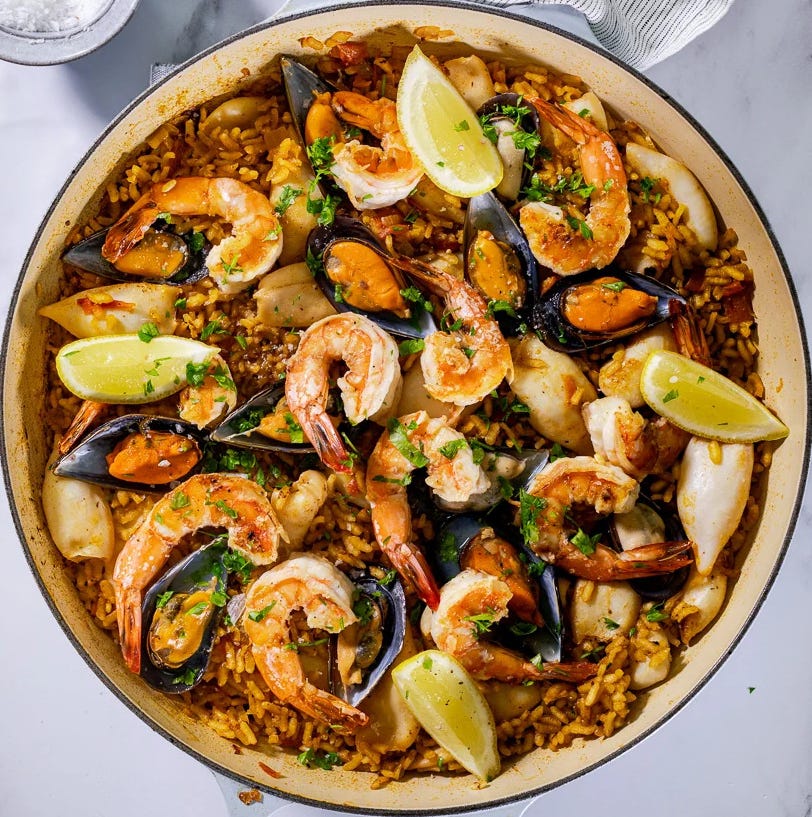
Inland Spaniards combined seafood with meat from land animals to create a mixed paella, sometimes called preparación barroca (baroque preparation) because of the variety of ingredients and its appearance.
There are literally hundreds of interpretations of paella (or “rice with things”). Look online at recipes and the number of paella cookbooks. Here we have a large Basque community where street paella is available weekly (even through the winter). Take a paella cooking class.
The tase of paella is all about freshness and promoting a healthy lifestyle. It provides excellent nutritional value; natural ingredients, no industrially processed foods, and is rich in vitamins and minerals. Further, paella promotes a social lifestyle. The bigger the pan, the more people can surround and enjoy.
Bon appétit or, more appropriately, disfrute de su comida !!!.
Superb!!! You have an immense amount of love for food - and especially for Paella - I think you should throw a paella party for anyone who reads this substack.... that would be great fun for all of us! Send your email info to Rick!